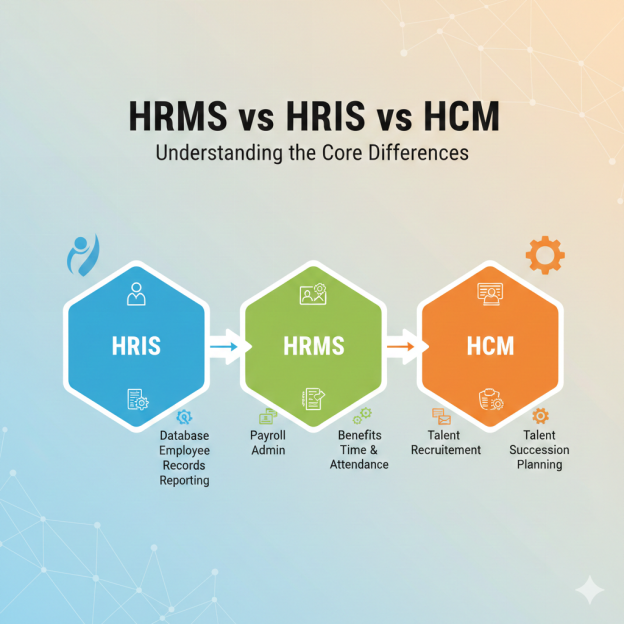

The development of HR technology has been phenomenal – from mere attendance tracking to the fully automated people management ecosystems that are in place today. However, as the industry changed, so did its jargon, and the terms HRMS vs HRIS vs HCM have become quite confusing. These terms are often used interchangeably by businesses, even though they have distinct meanings.
It’s hard to blame the people for mixing up these terms. As the tasks of HR expanded, so did the trend of the departmental tools, which are data-based processes, and employee growth support systems, and each of these has its own separate features. Present-day platforms, such as WeekMate HRMS, have taken this issue to another level by providing a myriad of features in one place.
Choosing the right HR Management Software can make a big difference in how effectively operations are carried out, reducing manual work while enhancing the employee experience. Till now, companies need to understand clearly the differences between HRMS, HRIS, and HCM first.
What Is HRIS (Human Resource Information System)?
An HRIS is primarily a digital system for storing, managing, and organizing employee information, often integrating performance evaluation tools to enhance workforce insights. Eventually, it is the first step towards the digitalization of personnel management.
Key Features
- Unified employee data repository
- Tracking for leaves and attendance
- Simple payroll processing
- Documentation for compliance
- Basic HR reports
Who Should Choose HRIS?
For a small company, a straightforward, reliable way to store employee data and manage routine HR tasks without complex features is an HRIS.
What Is HCM (Human Capital Management)?
Human Capital Management is a concept that goes beyond mere data handling and focuses on optimizing the employee lifecycle from onboarding to succession.
Key Features
- Talent Acquisition
- Employee Retention/Performance
- Learning and development
- Succession planning
- Labour planning
Who Should Choose HCM?
It is the best decision to implement HCM in a medium-sized enterprise with a focus on employee development and long-term workforce planning.
What Is HRMS (Human Resource Management System)?
HRMS = HRIS + HCM + advanced automation tools.
It is a platform that integrates employee data, talent management, and automates other HR processes.
Key Features
- All HRIS features
- All HCM capabilities
- Operations/workflow automation
- Employee and Manager Self-Service (ESS/MSS)
- Fingerprint & attendance integration
- Payroll accuracy tools
- HR dashboards & analytics
Who Should Choose HRMS?
HRMS can be an excellent solution for SMEs and big companies that are looking for a comprehensive HRMS Software that can automate their entire HR cycle. Several Indian companies have been employing such instruments as WeekMate HRMS, which is considered one of the HRMS Tools in India, in order to facilitate their routine HR operations.
HRMS vs HRIS vs HCM: Side-by-Side Comparison
| Category | HRIS | HCM | HRMS |
| Definition | Employee data system | Talent-focused strategy system | All-in-one HR automation suite |
| Scope | Basic HR operations | Strategic workforce management | Operational + strategic + automated processes |
| Modules | Attendance, payroll basics | Recruitment, performance, L&D | Recruitment, payroll, attendance, analytics, ESS |
| Automation Level | Low | Medium | High |
| Scalability | Small teams | Growing mid-size teams | SMEs & large enterprises |
| Cost | Budget-friendly | Mid-range | Balanced cost with long-term ROI |
| Ideal Use Case | Simple admin needs | Talent optimization | Full-suite digital HR |
This table simplifies the differences between HRMS vs HRIS and HRIS vs HCM in an understandable, practical way.
Choosing the Right Solution for Your Business
According to Company Size
- HRIS → Small businesses with the need for only data management
- HCM → Medium-sized companies focusing on talent development
- HRMS → SMEs & Enterprises requiring scalability and automation
According to Business Goals
Decide on:
- HRMS Software → if automation, analytics, and efficiency are what you need
- HCM → if your main concern is talent development and succession planning
- HRIS → if your only need is central employee data
According to the Budget
- HRIS → a low-cost entry point
- HCM → a moderate investment
- HRMS → top long-term value with a higher ROI
Reasons Why HRMS Is Becoming the First Choice of SMEs
Small and medium enterprises, not only in India but all over the world, are integrating HRMS systems into their workflow for the following reasons:
- Complete HR automation
- Manual work lessened
- Accurate payroll and attendance
- Cloud-based access
- Greater employee experience
- Reliable insights and analytics
By providing services such as payroll, attendance, shift scheduling, and onboarding, WeekMate HRMS-type solutions lighten the burden of everyday HR tasks for Indian businesses. SMEs on their path to growth will find this to be one of the most efficient HRMS tools in India.
Real-World Scenarios
A startup choosing HRIS:
For a 10-member team, storing employee data and basic attendance records is sufficient.
A mid-sized company choosing HCM:
Such a 200-employee company decides to use HCM for hiring, performance, and L&D, with a focus on internal leadership development.
An SME switching to a full-suite HRMS:
The 500-employee company utilizes HRMS Software to automate payroll, attendance, and onboarding processes so as to reduce errors and save time.
A manufacturing unit adopting an HRMS Tool in India:
With several shifts and biometric devices, the unit manages complex attendance, overtime, and compliance using an HRMS.
Final Verdict
The clearer it gets when you realize how different the systems you compare are: HRMS vs HRIS vs HCM.
- HRIS is your base — it stores and structures employee information, manages basic attendance and payroll, and supports administrative HR tasks.
- HCM is all about the future of the people behind the data — the processes of recruiting new talent, nurturing their abilities, enhancing their performance, and planning the next leadership.
- HRMS not only collects everything—it goes further by integrating data management, talent development, automation, analytics, employee handover, and more into a single digital ecosystem.
This is the principal reason why HRMS has become the preferred tool for businesses in transition. Beyond handling HR chores, the system actively facilitates HR’s involvement in the strategic management of the organization.
For most SMEs, an HRMS is the best long-term investment, as it significantly reduces manual labor, maintains accurate records, enhances the employee experience, and prepares the business for future expansion.
Solutions such as WeekMate HRMS go even further by providing a streamlined, full-suite platform explicitly tailored for Indian SMEs to handle payroll, attendance, leave, onboarding, shift management, and analytics.
Additionally, WeekMate’s e-Connect module strengthens this ecosystem by enabling seamless internal communication, faster request handling, and improved team collaboration.
Automation, reliability, and scalability together make WeekMate a device not only practically suited for the present but also ready for the future, and one that companies seeking to modernize their HR operations will find indispensable.
To streamline your HR processes, increase productivity, and deliver a great employee experience, you should consider a contemporary HR Management Software that suits your business. A platform like WeekMate is the perfect tool if you want to turn HR from a time-consuming manual task into an easy, automated, strategic function.